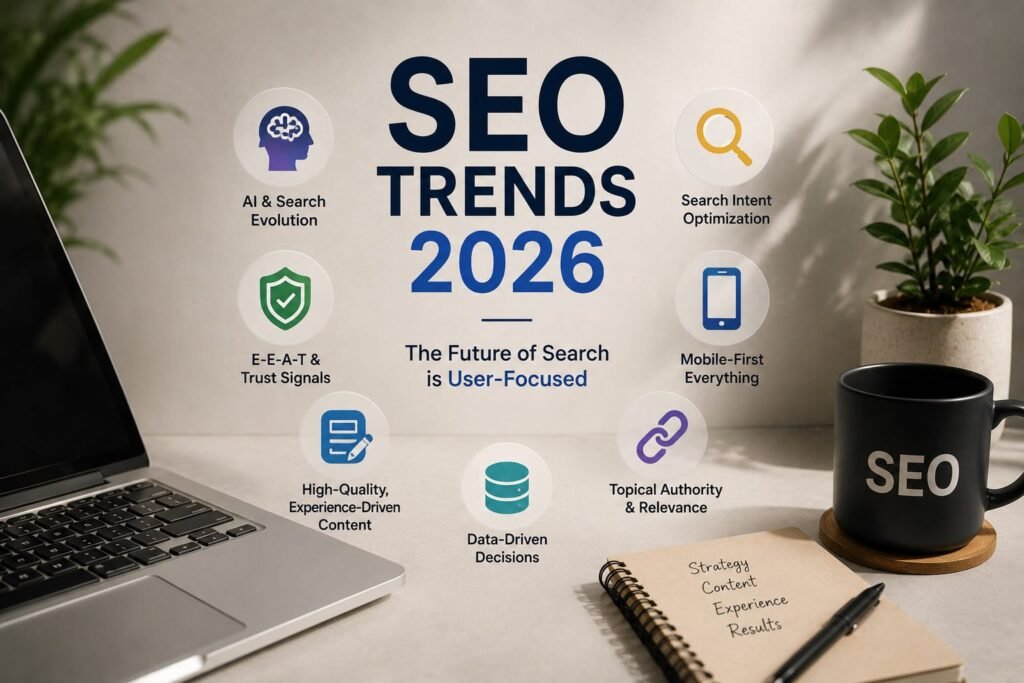
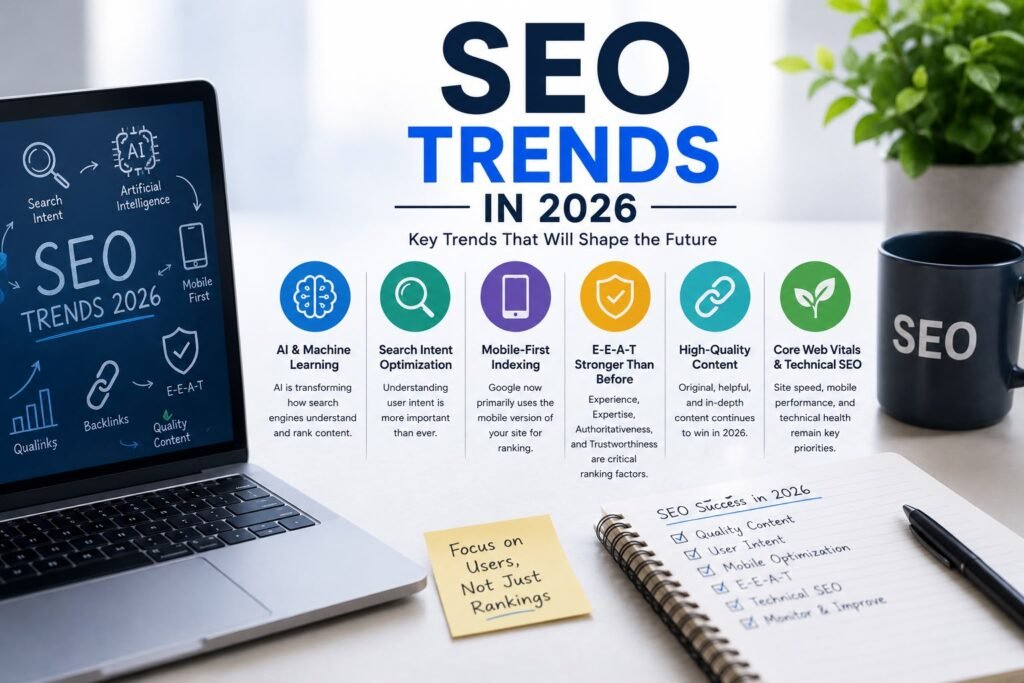
SEO Trends in 2026 are reshaping how websites rank on Google. If you’ve spent any time in SEO over the past couple of years, you’ve probably noticed how quickly search is evolving. AI-powered search, Google’s focus on E-E-A-T, and user-first content are changing the rules. In this guide, you’ll learn the biggest SEO trends in 2026 and how to prepare your website for long-term success.
Here’s what I’ve learned from working directly with sites through this shift, and what you can actually do about it.
Understanding SEO Trends in 2026 is no longer just about following algorithm updates. Businesses that embrace SEO Trends in 2026 by creating helpful, experience-based content and improving technical SEO will be better positioned for long-term organic growth. Throughout this guide, you’ll discover practical ways to adapt your content strategy to the latest SEO Trends in 2026 and stay competitive in search results.
1. Experience-Driven Content Is Outperforming Keyword-Chasing
For years, a lot of SEO strategy came down to identifying a keyword, writing around it, and hoping the rankings followed. That approach is losing steam fast.
The biggest win I’ve seen this year has come from a different approach entirely: publishing genuinely helpful, experience-driven content instead of chasing keywords alone. Pages that answer specific user questions with original insights, real examples, and clear structure have consistently outperformed generic, AI-generated articles covering the same topics—resulting in better rankings, higher engagement, and more organic traffic.
This isn’t a coincidence. Search engines are actively trying to reward content that demonstrates real, first-hand knowledge, which brings us to Google’s E-E-A-T framework—Experience, Expertise, Authoritativeness, and Trustworthiness. Content that only checks the “Expertise” box, without any lived Experience behind it, increasingly reads as thin to both readers and algorithms.
A Real Example
A B2B software company’s support article is a good illustration of this. It started as a fairly generic, keyword-focused piece. We rewrote it to include step-by-step instructions, original screenshots, an FAQ section, and real troubleshooting tips pulled from actual support tickets.
Over the following months, the page’s organic traffic increased by roughly 60%, and its average ranking moved from the second page of search results into the top five for several target queries.
Results like this won’t be identical for every site—outcomes depend heavily on your niche, competition, and how well the changes are implemented. But the underlying principle held true: specificity and real expertise beat generic coverage.
2. The Mistake That’s Going to Cost Sites in 2026
If there’s one habit worth breaking before 2026 gets underway, it’s this: publishing large volumes of AI-generated content without adding original expertise, unique data, or real value.
It’s an understandable trap. AI tools make it easy to produce dozens of articles a week, and for a while, sheer volume could move the needle. But search engines are getting noticeably better at recognizing content that lacks genuine experience or fails to satisfy what the searcher actually wanted to know.
Heading into 2026, the sites that win won’t necessarily be the ones publishing the most. They’ll be the ones prioritizing quality, building topical authority around subjects they actually understand, and keeping existing content updated rather than constantly starting new pages from scratch.
3. A Practical SEO Content Audit Process for 2026
You don’t need an elaborate, proprietary framework to apply these ideas—you need a repeatable process. Here’s a practical one you can adapt for your own site:
- Audit search intent and identify content gaps. Look at what your target audience is actually searching for, and where your current content falls short.
- Prioritize topics based on business value and topical authority. Not every gap is worth filling—focus on what moves your business forward and reinforces your expertise.
- Map one primary intent per page. This avoids keyword cannibalization, where multiple pages on your own site compete against each other.
- Improve content with original insights, examples, data, and expert perspectives. This is where the real differentiation happens.
- Strengthen internal linking. Make sure your best, most authoritative pages are easy to discover from related content.
- Optimize technical fundamentals. Core Web Vitals, indexing, structured data (schema), and mobile experience still matter—great content on a slow, poorly indexed site won’t perform.
- Monitor performance and refresh accordingly. Track rankings, clicks, engagement, and conversions, and revisit content based on what the data tells you—not on a fixed calendar alone.
This process isn’t about reinventing SEO. It’s about applying consistent discipline to the fundamentals while weighting your effort toward quality and originality.
4. Where SEO Is Heading: Beyond Keyword Rankings
Here’s a prediction that not everyone in the industry agrees with: traditional keyword rankings are going to become a less meaningful success metric than overall topical authority and brand trust.
As AI-powered search experiences continue to grow, more users are getting answers directly within search interfaces, rather than clicking through a list of ranked links. In that environment, websites that publish genuinely original research, first-hand experience, and expert insights are likely to outperform sites relying on scaled, keyword-focused content—even if those sites publish less frequently.
This doesn’t mean keyword research becomes irrelevant. It still matters for understanding intent and language. But keyword position alone is going to tell you less and less about whether your content strategy is actually working. Metrics like brand mentions, topical depth, and demonstrated expertise are likely to matter more.
Not everyone agrees with this shift, and it’s still playing out. But the direction seems clear: quality and credibility are increasingly outweighing sheer content volume.
5. AI Search and Google AI Overviews in 2026
AI-powered search is changing how people interact with search engines. Instead of simply displaying a list of links, Google increasingly provides AI-generated summaries that answer users’ questions directly. This means websites must focus on creating content that is accurate, trustworthy, and genuinely useful if they want to be cited in AI Overviews.
To improve your chances, write content that answers questions clearly, includes original insights, and demonstrates real experience. Use descriptive headings, concise paragraphs, and structured information so both users and search engines can easily understand your content. While clicks from traditional rankings may change, appearing in AI-generated search experiences can still increase your brand visibility and authority.
Businesses should also continue publishing unique case studies, customer success stories, expert opinions, and original research. These types of content are much harder to replicate and are more likely to be trusted by both users and AI-powered search systems.
6. Technical SEO Checklist for 2026
Even the best content won’t perform well if your website has technical issues. A strong technical SEO foundation helps search engines crawl, index, and understand your pages efficiently.
Before publishing new content, make sure your website loads quickly, works well on mobile devices, uses HTTPS, and has no broken links. Regularly monitor Core Web Vitals, submit an updated XML sitemap, and use structured data (Schema Markup) where appropriate. Internal linking should guide visitors to related pages while helping search engines understand your site’s structure.
Technical SEO isn’t about chasing every new trend. Instead, it’s about maintaining a fast, secure, and user-friendly website that delivers a consistent experience across all devices.
SEO Trends 2026: Quick Comparison
| Old Approach | 2026 Approach |
|---|---|
| Chase keywords first, add content after | Start with real expertise, map keywords to it |
| Publish high volumes of AI-generated content | Publish fewer, deeper, experience-backed pieces |
| Track keyword rank as the main KPI | Track topical authority, engagement, and trust signals |
| One-and-done publishing | Regular content refreshes based on performance data |
| Multiple pages competing for similar terms | One clear primary intent per page |
- SEO Trends in 2026 are changing the way businesses create, optimize, and maintain content for long-term organic visibility.
- Companies that understand SEO Trends in 2026 will be better prepared to adapt to future Google algorithm updates.
- One of the most important SEO Trends in 2026 is focusing on user experience instead of keyword stuffing.
- Following SEO Trends in 2026 helps websites build trust, authority, and sustainable search rankings.
- Every content strategy should align with the latest SEO Trends in 2026 to remain competitive.
- Small businesses can also benefit from SEO Trends in 2026 by publishing helpful, experience-driven content.
- Technical optimization continues to play a major role in SEO Trends in 2026.
- Understanding SEO Trends in 2026 allows marketers to create content that performs well over time.
- The websites that embrace SEO Trends in 2026 are more likely to achieve consistent organic traffic growth.
- Applying these SEO Trends in 2026 consistently can improve both search visibility and user satisfaction.
Frequently Asked Questions
What are the biggest SEO trends for 2026? The clearest trend is the shift away from keyword-volume strategies toward experience-driven, original content that demonstrates real expertise—paired with strong technical fundamentals like Core Web Vitals and structured data.
Is keyword research still important in 2026? Yes, but its role is changing. Keyword research is still useful for understanding search intent and language, but keyword rank alone is becoming a less reliable indicator of overall SEO success.
How often should I update existing content? Rather than following a fixed schedule, base updates on performance data—rankings, clicks, engagement, and conversions. Pages showing declining performance or outdated information are good candidates for a refresh.
Does AI-generated content hurt SEO? Not inherently, but AI content published at scale without original expertise, data, or real value tends to underperform. The issue isn’t the tool—it’s the absence of genuine insight behind the content.
Quick Checklist for SEO Trends in 2026
Before publishing any page, ask yourself:
- Does the content demonstrate real experience?
- Is the search intent completely satisfied?
- Have you naturally included the primary keyword SEO Trends in 2026 where relevant?
- Does the page load quickly and perform well on mobile devices?
- Have you added internal links to related articles?
- Are images optimized with descriptive alt text?
- Is structured data (Schema Markup) implemented where appropriate?
- Will this content still be useful six months from now?
If you can answer “Yes” to all of these questions, your content is far more likely to perform well in the evolving search landscape.
- Why SEO Trends in 2026 Matter for Every Website
- Understanding SEO Trends in 2026 is essential for businesses that want sustainable organic growth. Instead of focusing only on rankings, successful websites are creating valuable content, improving technical performance, and delivering a better user experience. By following SEO Trends in 2026, website owners can stay competitive, adapt to future search updates, and build long-term trust with both users and search engines. Investing in SEO Trends in 2026 today will help your website remain visible and relevant in the years ahead.
Final Thoughts
The SEO trends 2026 is bringing aren’t really about a single algorithm update or a new technical trick. They reflect a broader shift toward rewarding content that’s genuinely useful, backed by real experience, and built around clear intent.
If you take one actionable step away from this: pick one underperforming page, and rewrite it using real examples, first-hand insight, and a clear structure—rather than adding more generic pages. Then measure what changes.
SEO Trends in 2026: Action Plan for Website Owners
Understanding the SEO Trends in 2026 is only the first step. The real challenge is turning those insights into consistent action. Whether you run a business website, an e-commerce store, or a personal blog, success will depend on building a long-term SEO strategy rather than chasing short-term ranking gains.
Start by auditing your existing content. Remove outdated information, improve weak pages, and merge similar articles that compete for the same search intent. Refreshing older content is often more effective than publishing dozens of new articles.
Next, focus on demonstrating real experience. Add screenshots, case studies, customer examples, original research, and practical tips wherever possible. These elements help strengthen E-E-A-T signals and make your content more valuable for readers.
Technical performance should also remain a priority. Improve Core Web Vitals, optimize images, reduce unnecessary scripts, and ensure your website loads quickly on both desktop and mobile devices. A fast website improves user experience and supports better search visibility.
Internal linking is another area that many websites overlook. Connect related articles using descriptive anchor text so users can easily discover additional content. Search engines also use these links to understand your website’s topical authority.
Finally, monitor your SEO performance regularly through Google Search Console and analytics tools. Review impressions, clicks, keyword performance, and user engagement every month. Instead of reacting to every algorithm update, focus on creating content that genuinely solves problems and builds trust over time.
The biggest lesson from the SEO Trends in 2026 is simple: websites that consistently publish useful, original, and trustworthy content are more likely to earn sustainable organic traffic. Rather than trying to manipulate rankings, invest in content quality, technical excellence, and a better user experience. These principles will continue to deliver results even as search technology evolves.