Why People Click on Online Ads is a question that marketers and advertisers often ask. Every day, users are exposed to countless advertisements, yet only a small number receive clicks. Understanding the psychology behind ad clicks can help businesses create more effective advertising campaigns.
Discover why people click on some ads but ignore others. Learn the key elements that make advertisements effective.
Many marketers wonder why people click on online ads while ignoring others. Understanding why people click on online ads can help improve advertising performance.
Why People Click on Online Ads: Understanding Ad Click Psychology
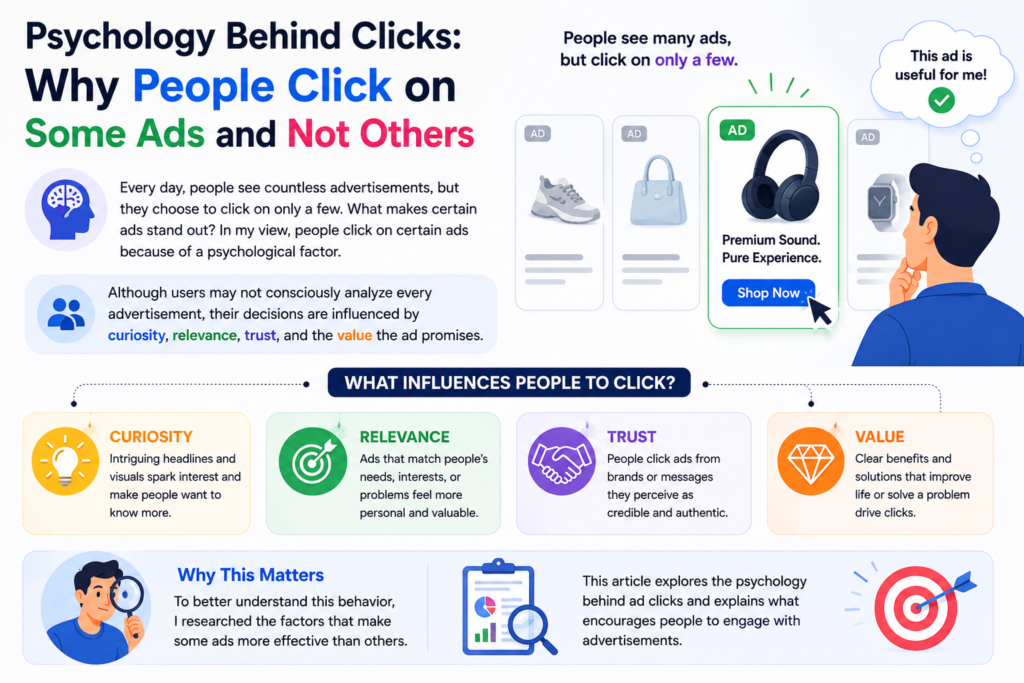
Every day, people see countless advertisements, but they choose to click on only a few. What makes certain ads stand out? In my view, people click on certain ads because of a psychological factor. Although users may not consciously analyze every advertisement, their decisions are influenced by curiosity, relevance, trust, and the value the ad promises.
To better understand this behavior, I researched the factors that make some ads more effective than others. This article explores the psychology behind ad clicks and explains what encourages people to engage with advertisements.
According to Google’s research, why people click on online ads is strongly influenced by relevance and user intent. Marketers can learn more from Google’s Think with Google platform, which provides insights into consumer behavior and advertising trends.
Why People Click on Online Ads: Understanding Ad Click Psychology
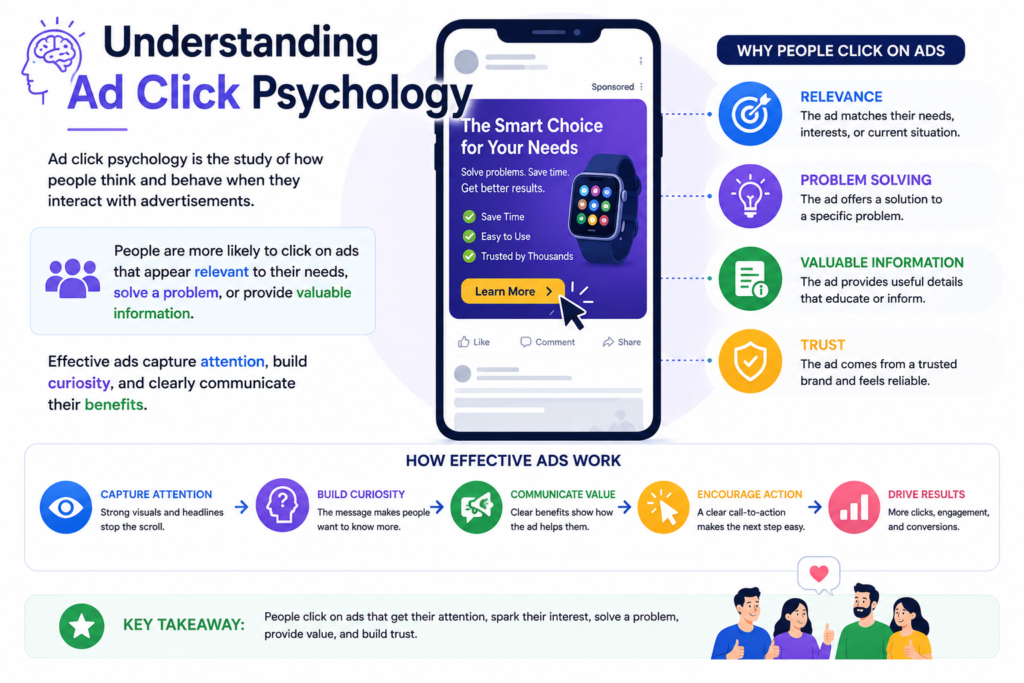
Ad click psychology is the study of how people think and behave when they interact with advertisements. People are more likely to click on ads that appear relevant to their needs, solve a problem, or provide valuable information. Effective ads capture attention, build curiosity, and clearly communicate their benefits.
An Example of My Ad-Clicking Experience
I once saw an advertisement promoting a product that immediately caught my attention. The ad clearly explained the product’s benefits and featured an attractive, professional design. It also allowed me to learn about the product without forcing me to provide my personal information.
The language used in the advertisement was simple, engaging, and authentic. Since I enjoy learning about language and communication, the ad appealed to my interests. Because it clearly explained the product’s value and built trust, I decided to purchase it.
This experience helped me understand why people click on online ads. The advertisement was relevant to my needs, communicated its benefits clearly, and made the next step simple. Instead of using exaggerated claims, it focused on providing useful information. As a result, I felt confident enough to click the ad and learn more about the product.
Understanding Ad Click Psychology
Some advertisements look visually appealing but fail to provide useful information. While they may attract initial attention, they often do not explain how the product or service solves a specific problem. As a result, users quickly lose interest and move on.
In my opinion, an advertisement that looks attractive but fails to answer the audience’s questions is ineffective.
Another important reason why people click on online ads is that the advertisement clearly matches their interests and expectations. When users immediately understand what the ad offers and how it can help them, they are more likely to click. In contrast, ads that use misleading headlines or unclear messages often lose the audience’s trust and receive fewer clicks.
Understanding why people click on online ads allows businesses to create better marketing campaigns. By focusing on relevance, trust, and clear communication, advertisers can improve user engagement, increase click-through rates, and build stronger relationships with their target audience.
My 5-Point Framework for Evaluating Ads
When deciding whether an advertisement is effective, I use the following five criteria:
These five elements help me identify advertisements that are informative, relevant, and worth clicking.
1. An attention-grabbing headline that clearly explains what the ad offers.
2. A clear explanation of the benefits so users understand the value.
3. A message that addresses a specific problem the audience wants to solve.
4. A clear call to action (CTA) that tells users what to do next.
5. Simple, engaging language that is easy to understand and builds trust.
The Power of Curiosity in Driving Clicks
The Power of Curiosity in Driving Clicks
Curiosity is one of the strongest psychological triggers behind why people click on online ads. People naturally want to learn more when an advertisement sparks their interest without revealing all the details at once.
As an advertiser, I believe it is important to create curiosity while still being honest and relevant. Understanding why people click on online ads helps marketers create advertisements that attract attention and encourage more clicks. Ads that are repetitive, confusing, or uninteresting usually receive fewer clicks.
What Causes People to Ignore Ads?
Several factors reduce the likelihood that people will click on an advertisement:
- The headline is vague or uninteresting.
- The ad focuses only on selling instead of solving a problem.
- The message is too general and not relevant to the audience.
- The advertisement does not clearly explain its benefits.
- There is no clear call to action.
- The design is cluttered or difficult to read.
- The advertisement appears untrustworthy or misleading.
Quick Reference Guide
An Effective Advertisement Should:
1. Have an attractive, informative headline.
2. Include an engaging introduction that creates curiosity.
3. Address a specific problem and provide a solution.
4. Clearly explain the benefits.
5. Include a strong call to action.
6. Use a clean, visually appealing design.
7. Build trust through clear and authentic messaging.
An Ineffective Advertisement Often:
1. Has a vague or confusing headline.
2. Focuses only on selling products.
3. Fails to address customer problems.
4. It is too general or lacks specific information.
5. Does not include a clear call to action.
6. Uses a cluttered or unattractive design.
7. Appears misleading or difficult to trust.
Frequently Asked Questions (FAQs)
Why do people click on online ads?
People click on online ads when the advertisement is relevant to their needs, builds trust, creates curiosity, and clearly communicates value.
Is design more important than the message?
No. While good design attracts attention, the message is usually the most important factor. An effective advertisement communicates a clear benefit and solves a problem for the audience.
What is the most effective psychological trigger in advertising?
Curiosity is one of the strongest psychological triggers in advertising. People naturally want to learn more when an advertisement sparks their interest without revealing all the details at once.
Does reducing friction in a call to action increase clicks?
Yes. Making it easy for users to take action—such as requiring fewer steps or less personal information—can increase click-through rates.
Why do people click on online ads?
People click on online ads when they are relevant, trustworthy, visually appealing, and offer clear value.
Conclusion: What This Means for Your Advertising
Understanding why people click on online ads can help create more effective marketing campaigns. Successful advertisements are not only visually attractive but also informative, relevant, trustworthy, and focused on solving real problems.
If one of my advertisements does not perform well, I analyze the results and improve the message instead of giving up.. Instead, I will analyze how I can improve it by making the message clearer, addressing the audience’s needs more effectively, increasing engagement, and creating a stronger call to action. Following my 5-point framework may require additional time and effort, but it can lead to more effective advertisements, better engagement, and improved campaign results.
By applying these strategies, you will better understand why people click on online ads and create advertisements that deliver better results
By understanding why people click on online ads, marketers can create advertisements that attract attention, build trust, and encourage meaningful user engagement.
Now you understand why people click on online ads and how psychology influences user behavior. Applying these principles can improve your advertising results.